
Los Angeles County City Directory Collections
The Los Angeles County collection at Los Angeles Public Library is the central historical keeper named in the research. Its City Directory Index and digitized browser bring together alphabetical entries, business volumes, telephone material, and street-reverse books. The Los Angeles County collection is strongest for Los Angeles and selected county communities, not every current city under one uniform run. Coverage language belongs beside the search result.
| Collection | Years | Where Held | Access |
|---|---|---|---|
| Los Angeles city directories | 1873-1942 paper and film; digitized selection within 1875-1987 | LAPL Central History & Genealogy; ResCarta | Onsite and digital |
| Historic city, business, and phone directories | 1873-1970 online run | LAPL ResCarta collections | Free browse and search |
| Street-reverse directories | 1906, 1927, 1956-1987 | LAPL ResCarta | Address and house-number view |
| Telephone directories | LA holdings from 1914; U.S. microfiche 1976-2005 | Central Library | Mostly onsite |
| Vital and newspaper indexes | Death 1905-1994; marriage 1949-1986; local runs vary | LAPL databases and microfilm | Index leads, not certificates |
The dated runs have gaps, competing editions, and uneven county coverage. A volume title, place label, and page citation matter as much as the name hit.
Los Angeles County Directory Years
The Los Angeles County record begins with an 1873 Los Angeles City Directory in the digitized browser. Early publication was irregular, and Atwood, Maxwell's, and Smith & McPhee editions competed in the 1880s. Later annual books became a census-between-censuses source. The reverse series is not continuous across the whole period: the inspected collection identifies 1906, 1927, and 1956 through 1987.
A practical timeline reads like this:
- 1873: the first Los Angeles volume record in the LAPL digital history.
- 1883-1888: competing early editions, including Atwood, Maxwell's, and Smith & McPhee.
- 1906 and 1927: selected street-reverse volumes add address-order evidence.
- 1956-1987: the surviving reverse run gives a long postwar address trail.
- After the printed era: telephone books, newspapers, archives, and current parcel records take a larger role.
The date on a search result is a source boundary. It is not proof that a person first arrived or left in that exact year.
Reading a Los Angeles County Directory
A Los Angeles County city directory entry is compact. For a Los Angeles County researcher, it may place a surname first, put a spouse in parentheses, list an occupation, and end with a residence address. A street-reverse volume changes the order and makes a house number the first clue. The volume's title page and abbreviation key should be read before the first search.
| Name | Alphabetized surname first; a spouse or given-name clue may follow. |
|---|---|
| Occupation | A trade or role that helps separate two people with the same name. |
| Residence | Address form, with h for householder or r for resides in the LAPL examples. |
| Widow mark | Widow notation and a spouse's given name can add a family clue. |
| Business entry | Trade and business address, which is an affiliation rather than a home. |
- Criss-cross directory
- A street-order section that places entries by address and house number.
- Householder index
- An alphabetical route to people listed as the main resident at an address.
- Abbreviation key
- The volume's guide to short forms for streets, occupations, relationships, and residence marks.
The marks tell what the book records. They do not turn an annual entry into a modern occupancy guarantee.
Los Angeles County Directory Search Fields
The LAPL digitized portal has more than a simple name box. The collection browser inspected during research listed 184 titles and allowed a searcher to move between collection, title, date, and keyword routes. A Los Angeles County search should preserve the exact spelling used by the volume as well as the modern spelling used in a family note.
| Collection or sub-collection | Choose Historic City and Business & Phone or Street-Reverse. |
|---|---|
| Simple keywords | Person, occupation, business, or exact directory-form address. |
| Browse titles | Page through listed volumes before assuming a missing year is absent. |
| Sort | Sort by publication date or title, ascending or descending. |
| Index keyword | Search all fields; ampersand means AND, slash means OR, and asterisk truncates. |
| City, county, state | Filter the holdings catalog with Los Angeles and the state abbreviation. |
The collection image below is from the LAPL digitized city and street directory page.
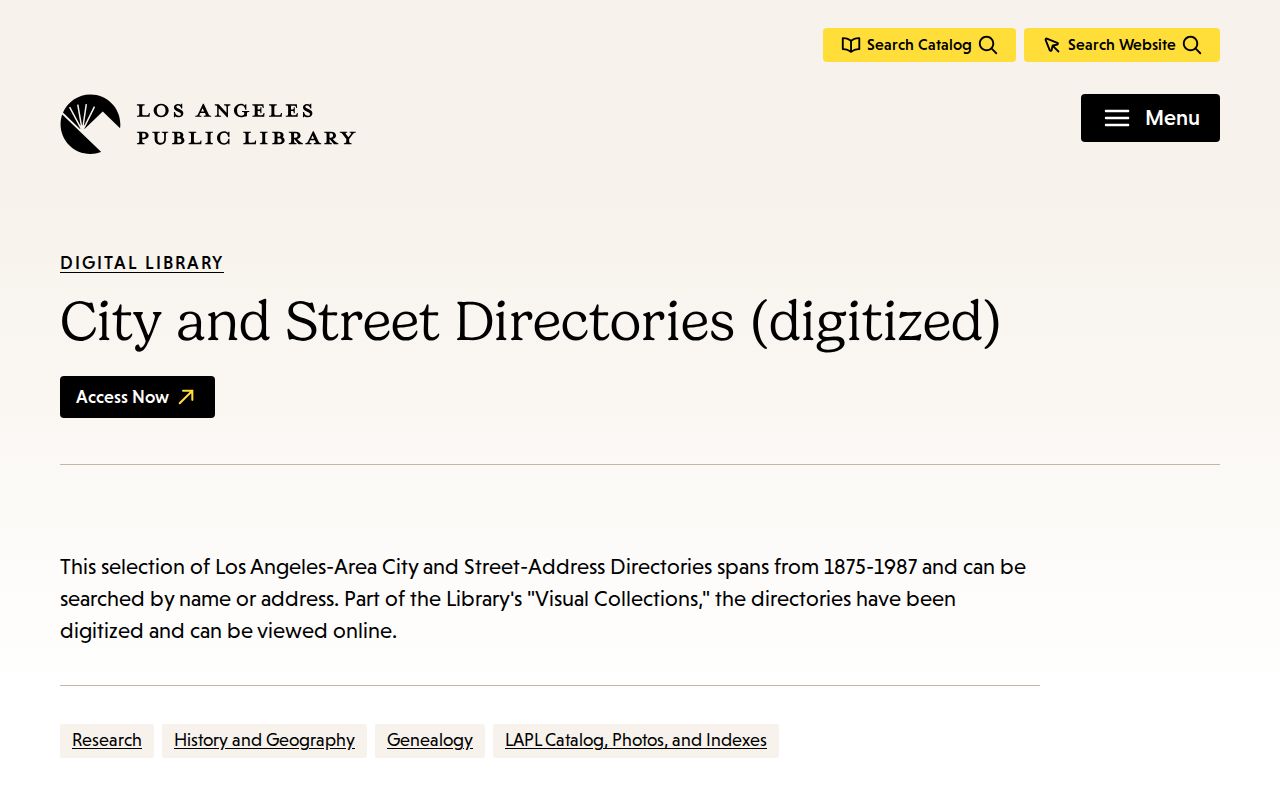
Use the field that matches the volume. A broad keyword search can miss an address when the scan uses a prefix or a historic street abbreviation.
Los Angeles County Address Marks
For a Los Angeles County address search, LAPL warns that address full-text searching may need the householder or resident prefix. A query such as `h443 N Av 52` can work where bare digits fail. Test “Ave 64” beside “Avenue Sixty-Four,” and “Broadway” beside “Bway.” Numbered streets and avenues can file before, after, or among named streets.
Read the page image, not only the OCR snippet. Check the entry's surname, spouse, occupation, residence mark, and surrounding names. If the same address appears with a different name, note the year and the volume title before treating it as a household change. A missing line can result from OCR, an omission, a move, a death, a surname change, an annexation, or a street renumbering.
The search display below comes from the LAPL ResCarta directory browser.
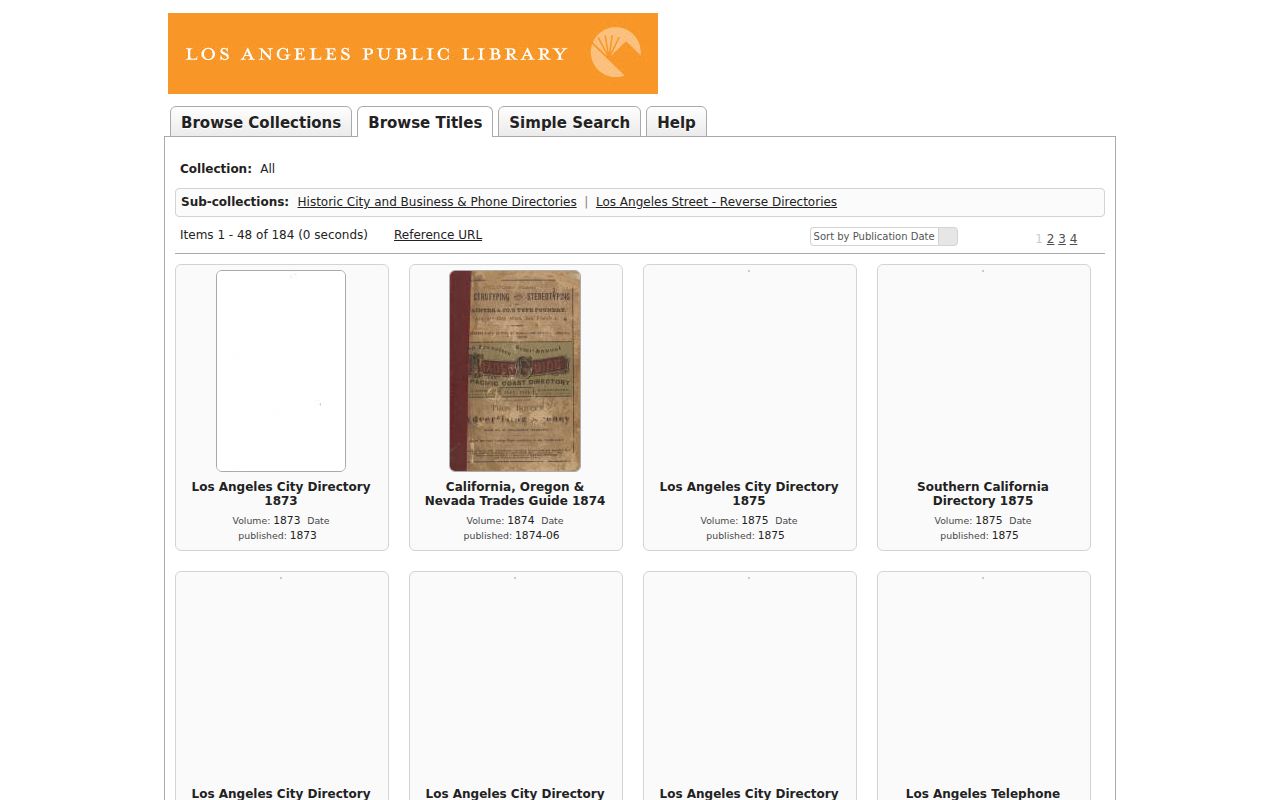
Historical spelling is evidence. It is not an error to be silently corrected.
Los Angeles County Reverse Directories
The Los Angeles County reverse series is the best fit for a street or house-history question. The selected 1906 and 1927 volumes, followed by 1956 through 1987, put the address before the person. That order can show a named occupant, a business, and nearby entries in the same block. It remains selective: early volumes include some county residents, and later books may include selected county cities rather than every modern community.
Start with the target year, read the filing instructions, then inspect adjacent annual or nearby volumes. A street-reverse entry is a historical household clue. It does not prove current residence or ownership. The current address chain belongs with Assessor, GIS, permits, and RR/CC sources.
The collection browser used for the reverse-directory image is LAPL's searchable directory collections.
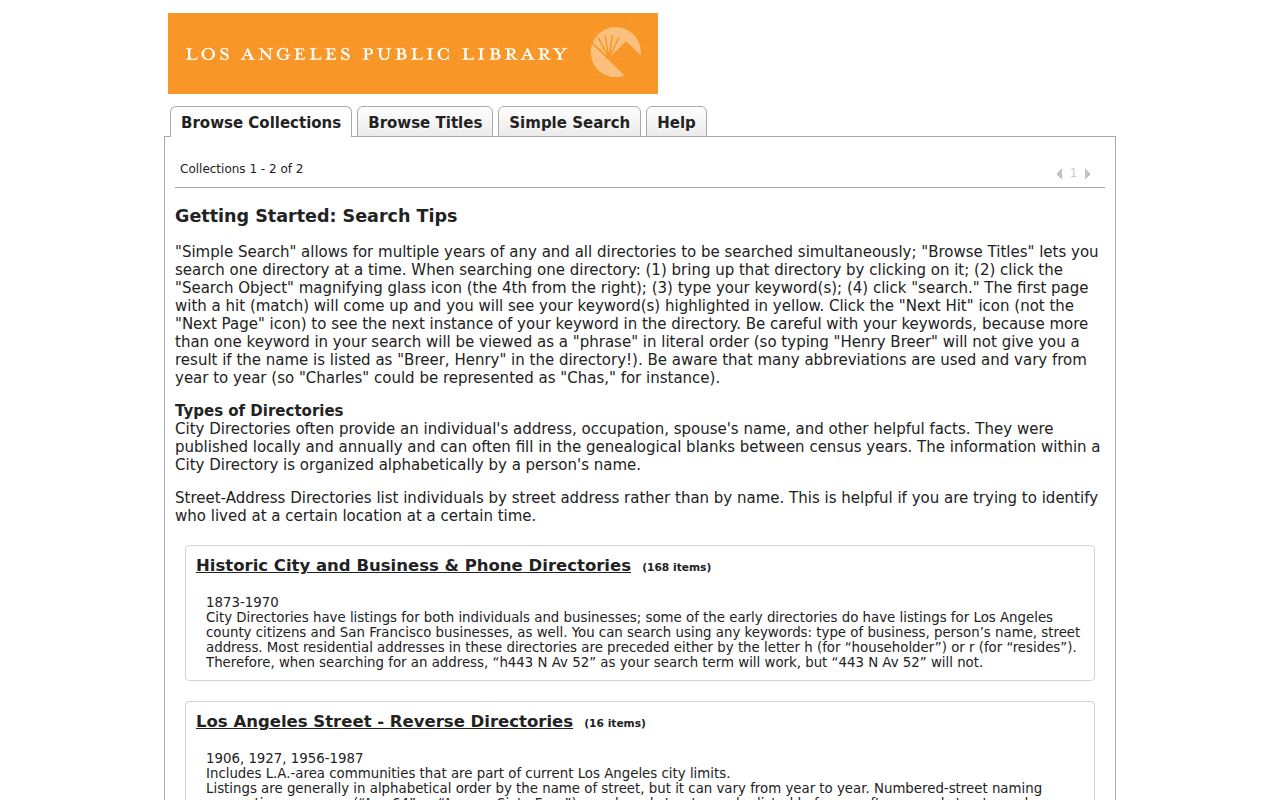
Keep the year, page, street form, and image citation together when a reverse result becomes a family clue.
Los Angeles County Directory Publishers
Competing early publishers make the Los Angeles County city directory story unusually useful for genealogy. Atwood, Maxwell's, and Smith & McPhee editions can overlap while using different abbreviations and editorial choices. A person absent from one book may appear in another. Compare the title page, publication date, city or county scope, and entry layout before merging records.
The LAPL City Directories Index supplies a Los Angeles County catalog route to paper and microform holdings. The Central Library also holds telephone volumes from 1914 forward, U.S. microfiche from 1976 through 2005, and many paper runs before 2012. Telephone books can extend a name or number clue, but they should be paired with a directory, newspaper, court, or vital source.
The holding index shown here is the LAPL City Directories Index.
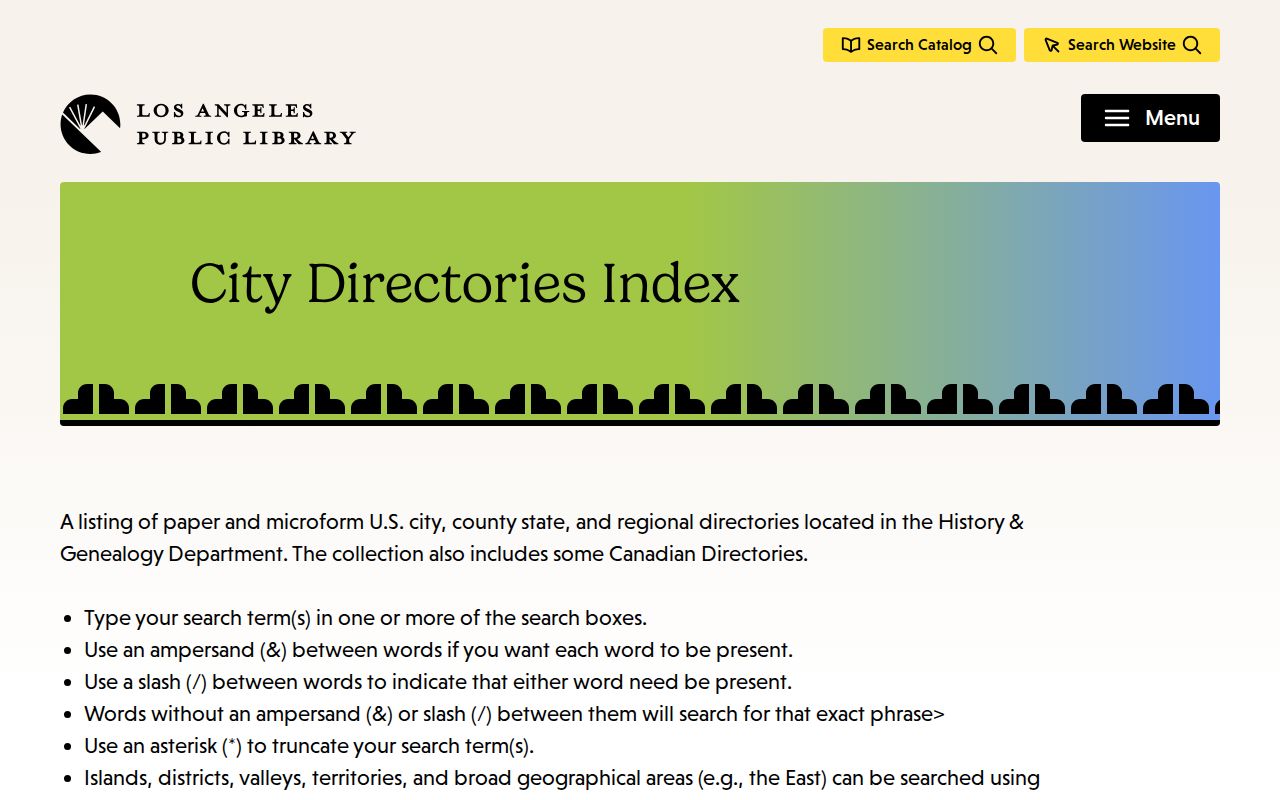
Publisher differences are a reason to search more than one volume, not a reason to invent a smooth annual run.
Tracing Los Angeles County Directory Households
Los Angeles County directory research works best as a year-to-year trail. Pair names and addresses with the federal census, then use obituaries, probate, cemetery transcriptions, newspapers, or a vital index to explain a disappearance. A directory entry can show who was listed, but it does not always state every member of a household.
- Choose a target year and record the title, place scope, page, and abbreviation key.
- Search surname variants and the exact historic address form, including residence prefixes.
- Read the alphabetical entry, then flip to the reverse section for the same street or house number.
- Compare the closest released census household and note relationships, ages, and address clues.
- Check the next directory years, then close the trail with an obituary, probate record, cemetery source, or death index.
As of 2026, the 1950 federal population schedule is the latest public census under the 72-year release rule. It can anchor the middle of a directory trail, while LAPL's local collections fill the years around it.
Los Angeles County Census and Directories
LAPL's census holdings include federal census film for 1790 through 1900 and 1920, with partial 1910 and 1930 material in its library collection. NARA and partner databases carry released schedules. Census pages use enumeration geography and household relationships, while a city directory tends to use a yearly name and address. Agreement across both is stronger than either alone.
The national census research route shown below is the National Archives census guide.
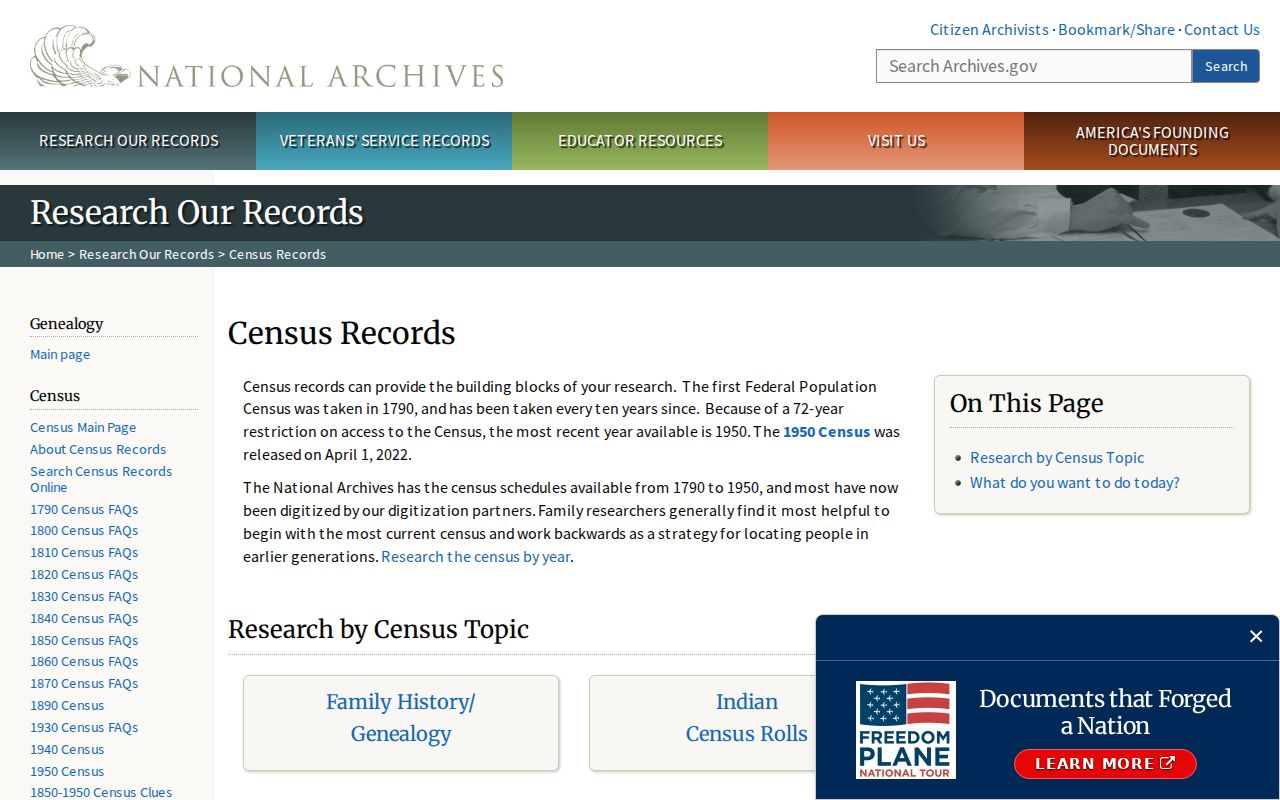
Use census geography with care. Annexation and street changes can make a modern city label misleading when reading a historic schedule.
Los Angeles County Directory Companions
When the annual volume stops or skips a year, LAPL's surrounding collections can keep the trail alive. The library lists California Eagle from 1914 through 1964, Daily News from 1923 through 1954, Evening Post-Record from 1896 through 1936, and Los Angeles Evening or Hollywood Citizen News from 1907 through 1970 among its local newspaper resources. A newspaper notice can supply a spouse, relative, address, service date, or community clue.
Photo collections, family histories, maps, telephone books, yearbooks, and community archives add texture. Community-specific repositories may have their own privacy rules. A funeral-home obituary or user-created memorial is a lead until it matches an official index, newspaper, cemetery, probate file, or library source.
Los Angeles County Directory Coverage
“Los Angeles” can mean the city, county, postal city, metropolitan area, or a court district. An annual volume may include early county residents, while a reverse volume may include selected cities. Do not treat the collection as an exhaustive Los Angeles County resident directory. Record the volume's own coverage statement and the community name printed on the page.
For modern parcel questions, use the address-keyed record chain instead. For an old house, use the annual volume, reverse directory, census, map, newspaper, probate, and vital layers together. A city directory is strongest when its limits are stated plainly.