
Finding Los Angeles County Residents
Los Angeles County has 88 incorporated cities and a large unincorporated area. That geography matters before any name search begins. A City of Los Angeles permit, a Long Beach business filing, and an unincorporated parcel can sit in the same county deed system while using different local offices. A parcel record may show assessed facts. A deed names parties to a transfer. A voter check confirms only a supplied combination of identity details. A directory entry gives historical context. None is a complete list of everyone at an address.
Start with the strongest key. Use an address to reach the Assessor Portal and its AIN, or use a full name with a date, city, case type, occupation, or family clue. Keep the result date and source beside each finding. A Los Angeles County resident directory search becomes safer and more useful when ownership, occupancy, litigation, family history, and civic records are kept as separate questions.
- Check the Los Angeles County Assessor Portal by address or AIN to identify the parcel and its physical facts.
- Use the Los Angeles County voter verification form only when the last name, birthdate, house number, and five-digit ZIP are already known.
- Convert the parcel clue into a grantor, grantee, and recording-year request for the Registrar-Recorder/County Clerk.
- Search the Los Angeles Public Library's historical directories, newspapers, and vital indexes for older residents and family clues.
- Send a narrow California Public Records Act request when the needed existing record is not exposed online.
Los Angeles County Records Offices
The Los Angeles County trail crosses several custodians. The Registrar-Recorder/County Clerk, known as RR/CC, handles real-estate instruments, clerk filings, elections, and vital-record channels. The Assessor connects an address or AIN to parcel characteristics. The Superior Court keeps case indexes and files. Libraries and archives supply the historical layer. Treat each office as a keeper of one record set, not as a shared database.
Los Angeles County RR/CC
Norwalk records counter
12400 Imperial Highway
Norwalk, CA 90650
800-201-8999
Los Angeles County Assessor
Basic, Legal, and Map Search
Address or ten-digit AIN
Owner display is restricted online
Los Angeles County Elections
Self-verification and file requests
Use is controlled by California law
800-815-2666
Norwalk is the central RR/CC contact named in the research. Recorder viewing guidance separates older material from later material by floor and recording-year range. The Los Angeles County copy page describes real-estate holdings from 1850, while the viewing guidance begins at 1851. That small difference should remain visible in a careful search note.
Los Angeles County Deed Records
The RR/CC real-estate index has an important quirk: it is organized by grantor, grantee, and year, not by street address or APN. A person who starts with a house therefore needs a bridge. The Assessor supplies an AIN, legal description, and parcel context. A permitted ownership clue can then become a name-and-year request at RR/CC. The public record may include deeds, deeds of trust, liens, releases, maps, and other recorded instruments, but the complete document image is a separate copy request.
The official Los Angeles County RR/CC deed FAQ explains the fields and the absence of a remote address search. Search routes can be online, in person, or written, depending on the record and request channel. The guidance quotes a $0.50 per name per year real-estate search fee for one channel, and a copy schedule of $6 for the first page plus $3 for each additional page in that guidance. Other order and certification charges vary, so the current custodian page controls.
The image below comes from the official RR/CC real-estate request route.
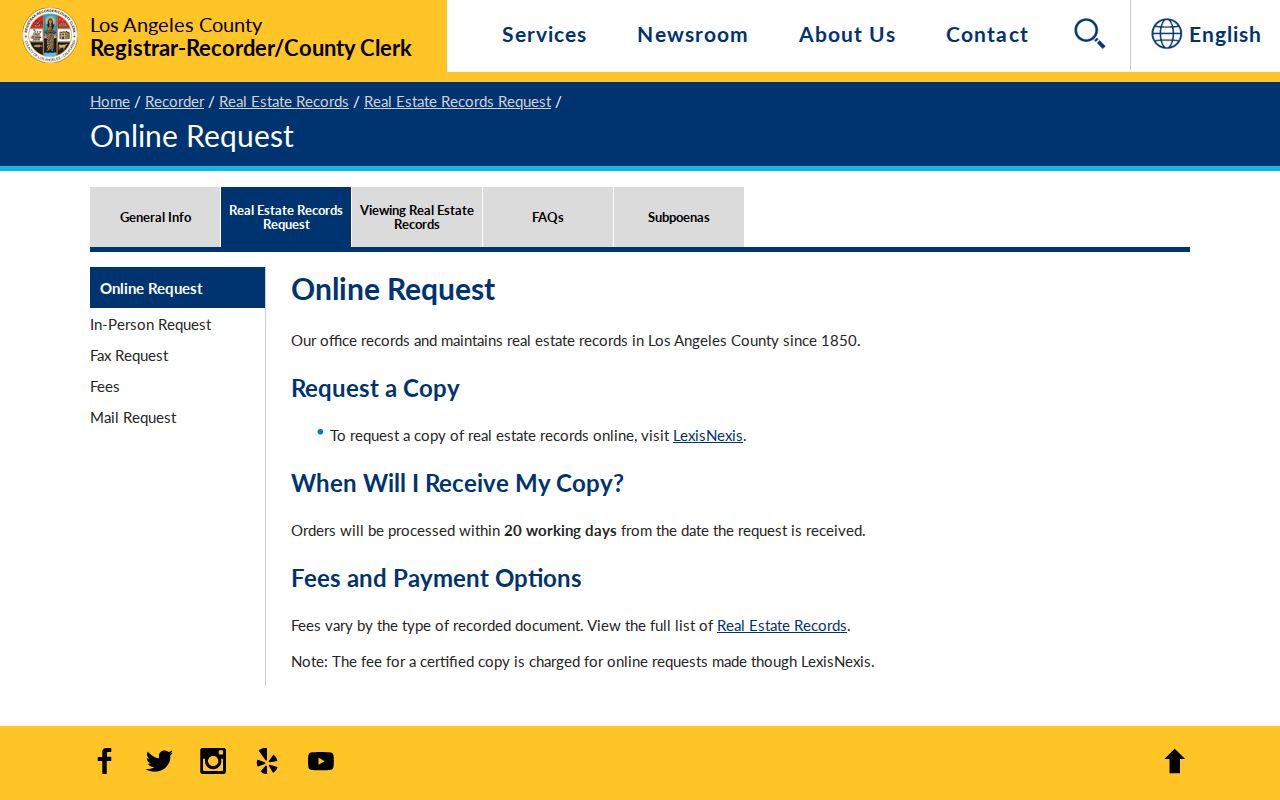
A recorded instrument can name grantor and grantee, recording year and document number, title, dates, and a legal description. It shows a transaction or encumbrance. It does not by itself prove that a named party lived at the situs address.
Los Angeles County Assessor Records
The Los Angeles County Assessor Portal is the cleanest first stop for a known address. Its Basic Search, Legal Search, and Map Search use an address or AIN to return parcel facts. A parcel card may include the situs address, legal description, use code, land and improvement values, tax-rate area, square footage, year built, beds and baths for residential property, and map context. Public internet results may suppress the owner's identity under California privacy and safety rules.
Situs means the physical location of the assessed parcel. A mailing address is where assessment correspondence goes. They can differ for many reasons. A mailing address is not proof that an owner lives elsewhere, and an assessor record is not a household list. The portal can help tie a street to a parcel, but occupancy needs separate evidence.
| Search mode | Basic Search for address or AIN; Legal Search for legal-description work; Map Search for spatial browsing. |
|---|---|
| Address field | Autocomplete text labeled “AIN or Address”; the AIN is a ten-digit Assessor Identification Number. |
| Search result | Parcel identity, legal description, use, values, structural facts, and map context where available. |
| Identity limit | Owner identity may be suppressed online; district-office or Property Data Sales routes may be needed. |
The portal view below is the county Assessor search captured for this resident directory.
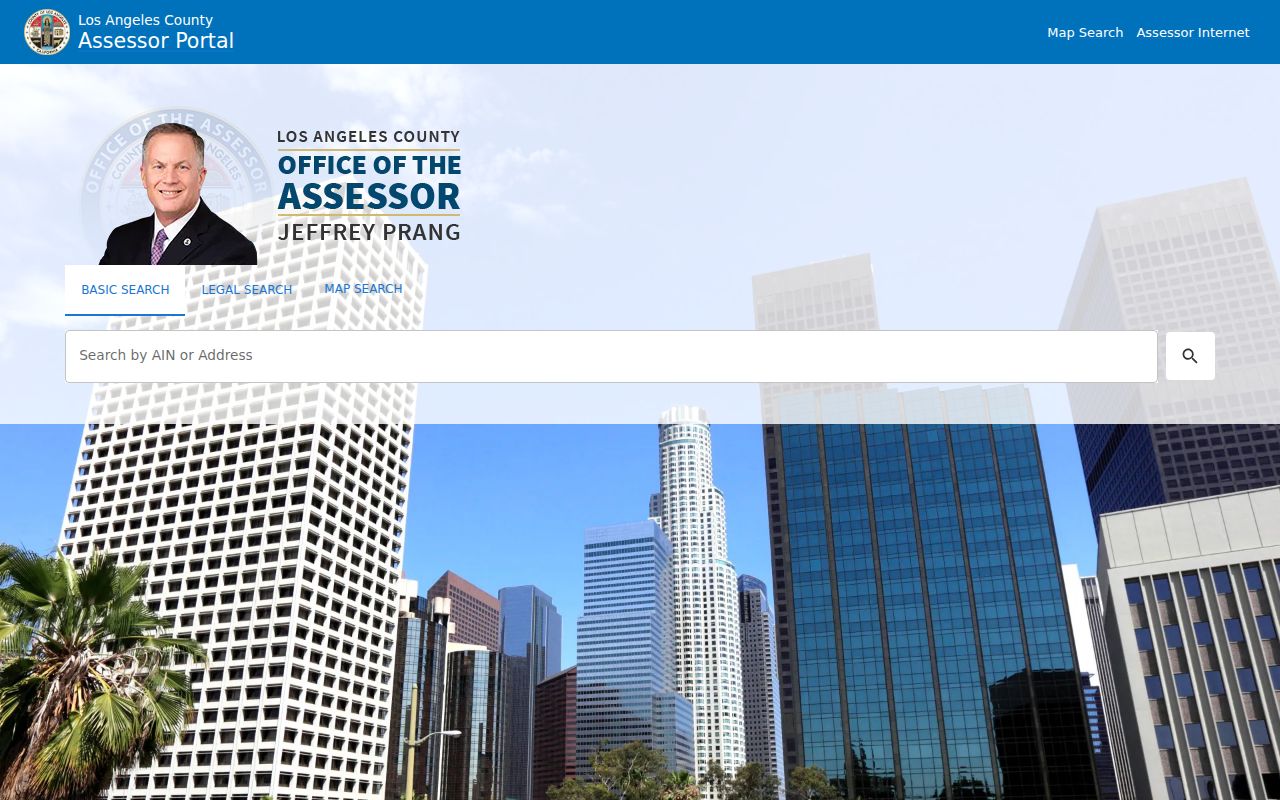
Record the AIN, map date, and legal description before moving to deeds or planning records. A map polygon is not a deed, and a parcel result cannot reveal every person who shares the address.
Known Voter Verification
Los Angeles County's voter page is a self-check, not a browseable voter roll or street directory. It asks for four facts that the requester should already possess. A match verifies the supplied combination for the person who entered it. It does not let a searcher list every registrant at an address, and it does not reveal how someone voted.
| Last Name | Required alphabetic text. |
|---|---|
| Birthdate | Required date in month, day, and year form. |
| House Number | Required numeric residence number. |
| ZIP Code | Required five-digit ZIP. |
| Result | Verification of the supplied combination, not an open list of voters. |
Use is controlled by Elections Code sections 2180 through 2194. Voter information is limited to approved electoral, scholarly, journalistic, political, or governmental purposes. Driver-license numbers, state-ID numbers, Social Security numbers, signatures, and protected participant addresses are not public. A qualified Los Angeles County file request has its own form, purpose statement, security plan, geography choice, and certification fields.
The four-field form is shown at the LA County Voter Registration Verification page.
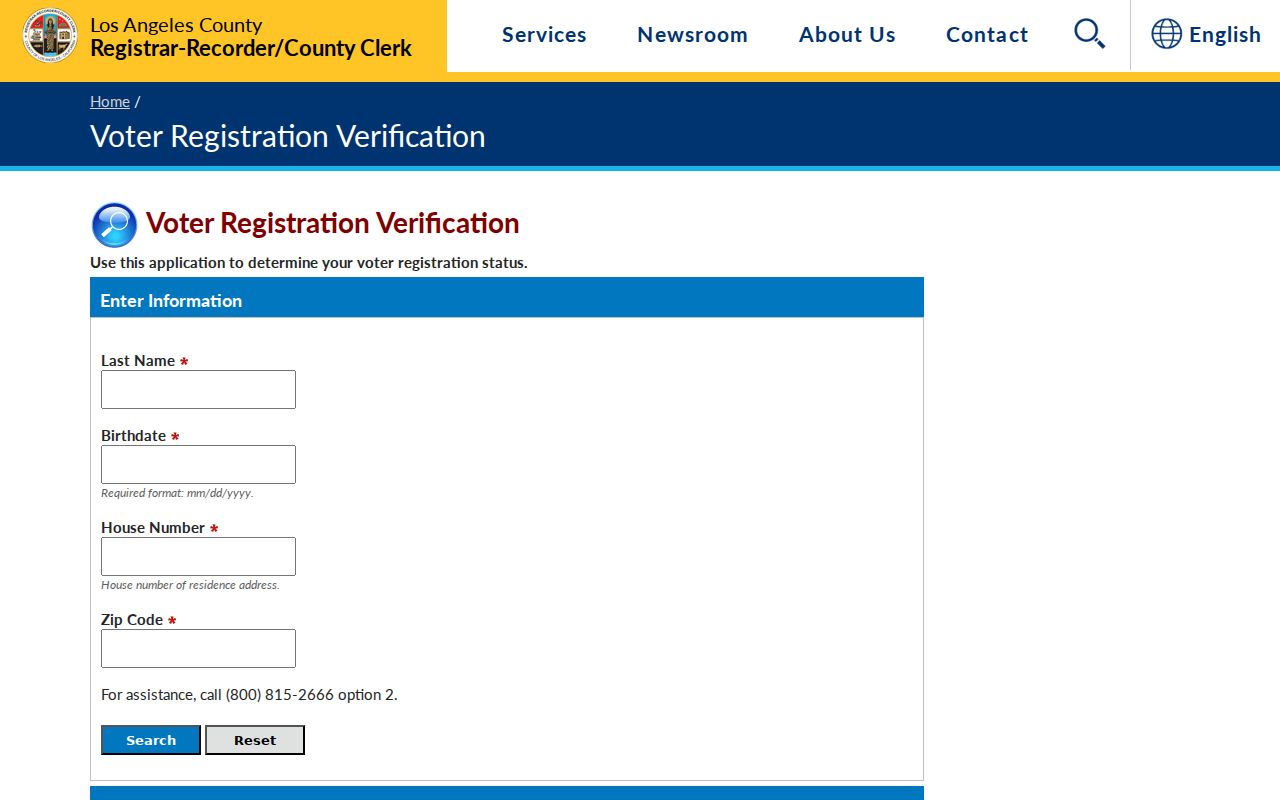
For a current resident directory search, voter verification is corroboration only. It cannot replace a court, deed, vital, or library source.
Current Los Angeles County Directory Sources
Current Los Angeles County records behave like separate directories with different meanings. A Los Angeles County residents directory is therefore a map of record custodians, not a single roster. An assessor result is parcel evidence. A voter result is a self-confirmed status check. A court index identifies a litigant or defendant in a case. A license or entity filing shows a public affiliation. The useful question is not “which list has everyone,” but “which custodian can answer this part of the identity question?”
| Source | Who or What It Names | Keeper | Access |
|---|---|---|---|
| Assessor parcel record | Parcel facts and possible ownership clue | Los Angeles County Assessor | Free portal; owner display limited |
| Voter verification | Known person and supplied residence facts | RR/CC Elections | Free self-check; statutory limits |
| Recorded instrument index | Grantors, grantees, liens, and releases | RR/CC Recorder | Request and copy routes |
| Court party index | Litigants, case type, date, place, and image count | Los Angeles Superior Court | Paid name search; free case-number summary |
| Business or license index | Entity roles or professional status | California SOS or DCA | Free public searches |
Dates and geography make the difference. A professional license can separate two people with the same name. A court case can add a filing location. A parcel can establish a property connection. A historical directory can add spouse, occupation, or an old street form. The Los Angeles County resident lookup page uses those distinctions for a one-person check.
Los Angeles County Court Records
The Los Angeles County Superior Court separates several paths. Case Access by case number is free. Calendar and case-summary tools answer event questions. Civil, family, probate, and small-claims party-name searching is paid, as is the criminal defendant route. Published civil coverage begins in 1983 for unlimited civil, probate, and family matters, in 1991 for limited civil, and in 1992 for small claims. Older matters need an Archives inquiry or courthouse route.
The party index can return litigant names, case type and number, filing date and location, and the count of eligible images. A name search is charged before results and is nonrefundable even when no match appears. Guest results remain available for two hours, and purchased documents for 30 days. Images cost $1 per page for pages one through five, then $0.40 per page, with a $40 maximum per document under the cited FAQ. Criminal images are not offered on the public web.
The image below is from the Los Angeles Superior Court civil party-name index.
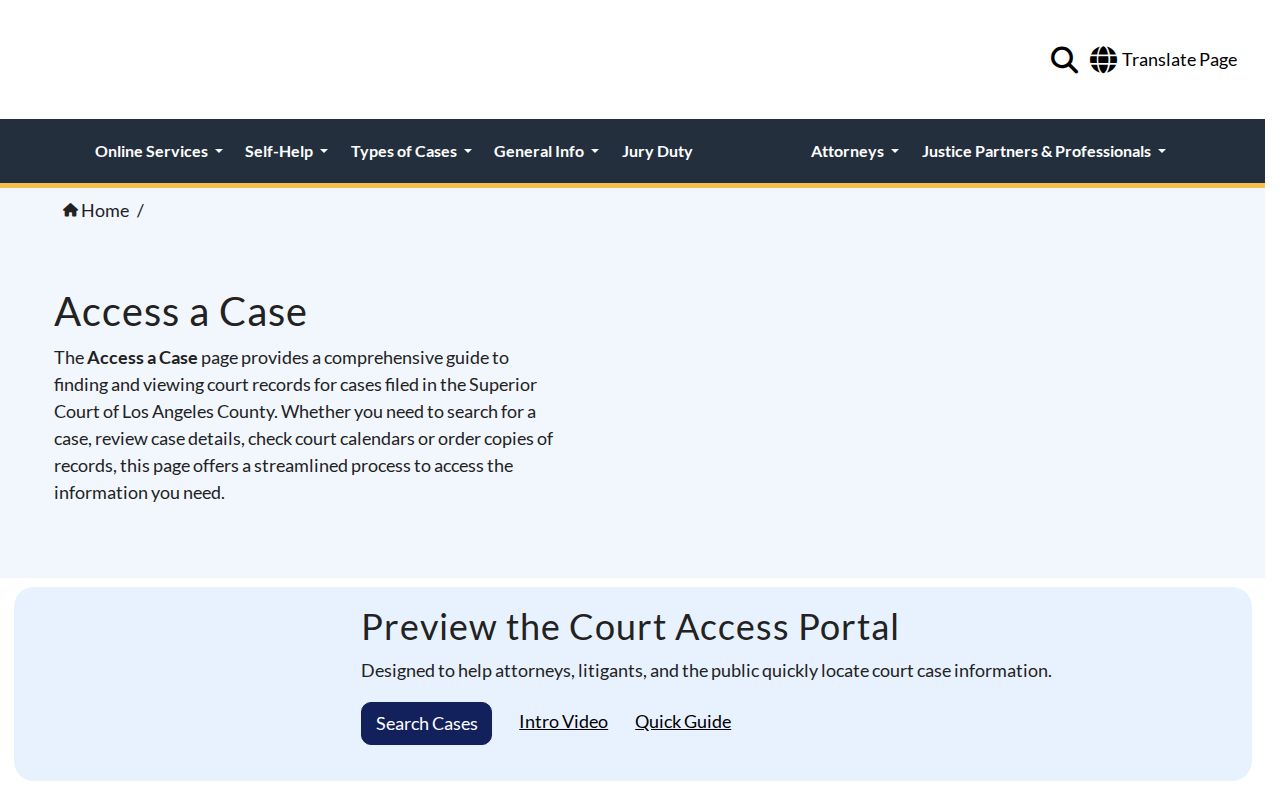
A docket is the court's running event record. Check party role, courthouse, dates, and case geography before treating a same-name result as a match. The online summary is not the official court file.
Los Angeles County Vital Records
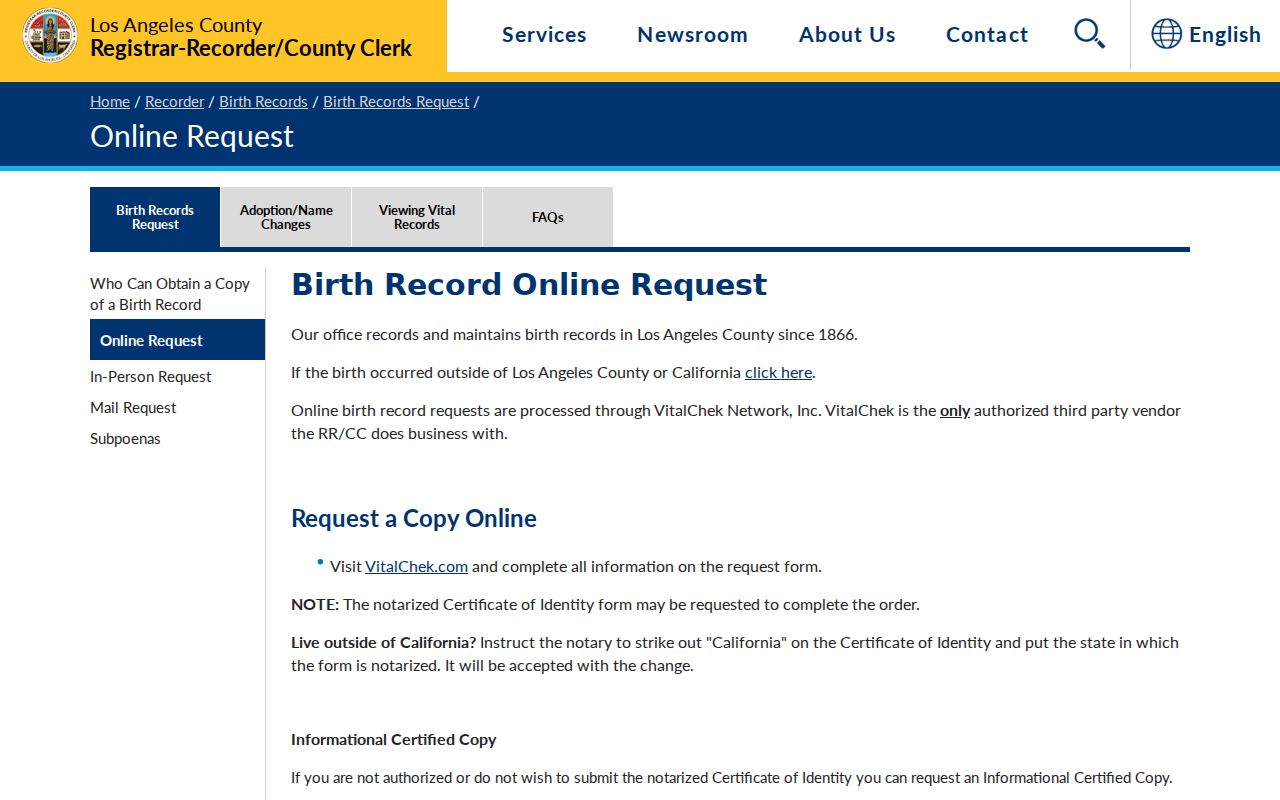
Los Angeles County birth, death, marriage, and divorce evidence use different custodians and access rules. RR/CC maintains county births from 1866 and county death and marriage records, while the California Department of Public Health is the statewide issuer. A historical index at the library can supply a name, date, county, spouse, or parent clue. An index is not a certified certificate.
The county birth route states $34 for an authorized certified copy and a 20-business-day online processing period. Appointment delivery is generally same-visit for 1962 onward except 1972 through 1977. Older years and informational copies are mailed within 20 business days. Authorized copies require a statutory relationship and a sworn Certificate of Identity. Informational copies are marked as not valid to establish identity. Confidential marriage and adoption records remain separate, restricted categories.
The county birth-copy application is the source for the Los Angeles County vital-record route.
State CDPH fees and processing differ by record type. Current research lists $31 for a birth copy, $26 for death, $19 for marriage, and $18 for a dissolution certificate in 2026, with ordinary processing often four to six weeks. Check the issuing office before ordering.
Los Angeles County Business Records
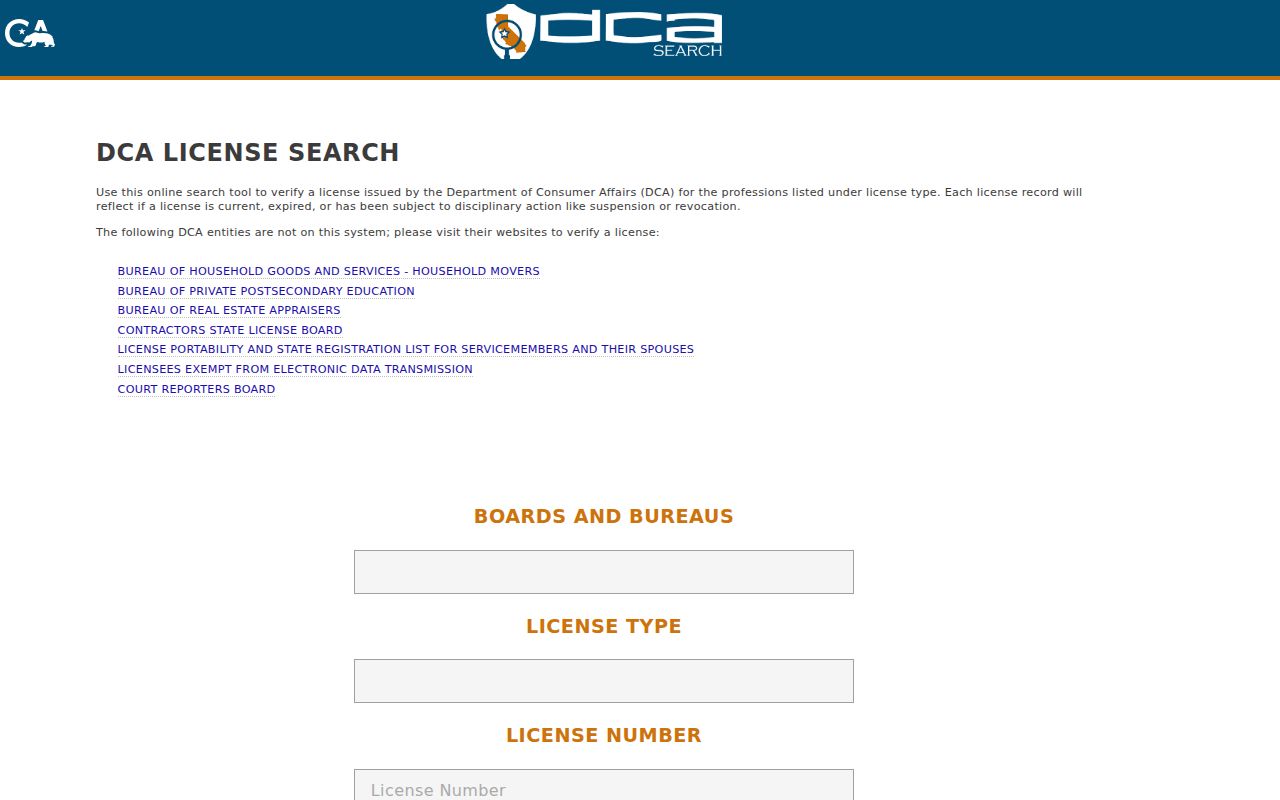
Business and professional records can separate people with the same name, but they show affiliation, not residence. California Secretary of State bizfile can return entity status, jurisdiction, principal and mailing addresses, an agent for service, officers or managers reported on statements, filing dates, and available PDFs. The DCA search can return a license number, type, status, issue and expiration dates, city or address where published, and discipline links.
The DCA search fields include board or bureau, license type, license number, business name, first and last name, and registry number. Advanced choices can add city, county, status, public documents, and disciplinary actions. The Secretary of State system searches by name or file number, with entity-type, status, date-range, and Begins With controls. Keep the board and retrieval date because status and fields change.
The state license search used for the image is the California Department of Consumer Affairs public search.
A county fictitious-business-name filing, a state entity, and a professional license can corroborate a name or community. None converts a business address into proof of a home address.
Los Angeles County Historical Directories
Los Angeles Public Library collections form the historical shelf for a Los Angeles County residents directory search. Printed Los Angeles directories run in paper and film from 1873 through 1942, with a digitized selection reaching across 1875 through 1987. The ResCarta collection lists Historic City and Business & Phone Directories from 1873 through 1970, and street-reverse volumes for 1906, 1927, and 1956 through 1987. Coverage of every modern county community is not uniform.
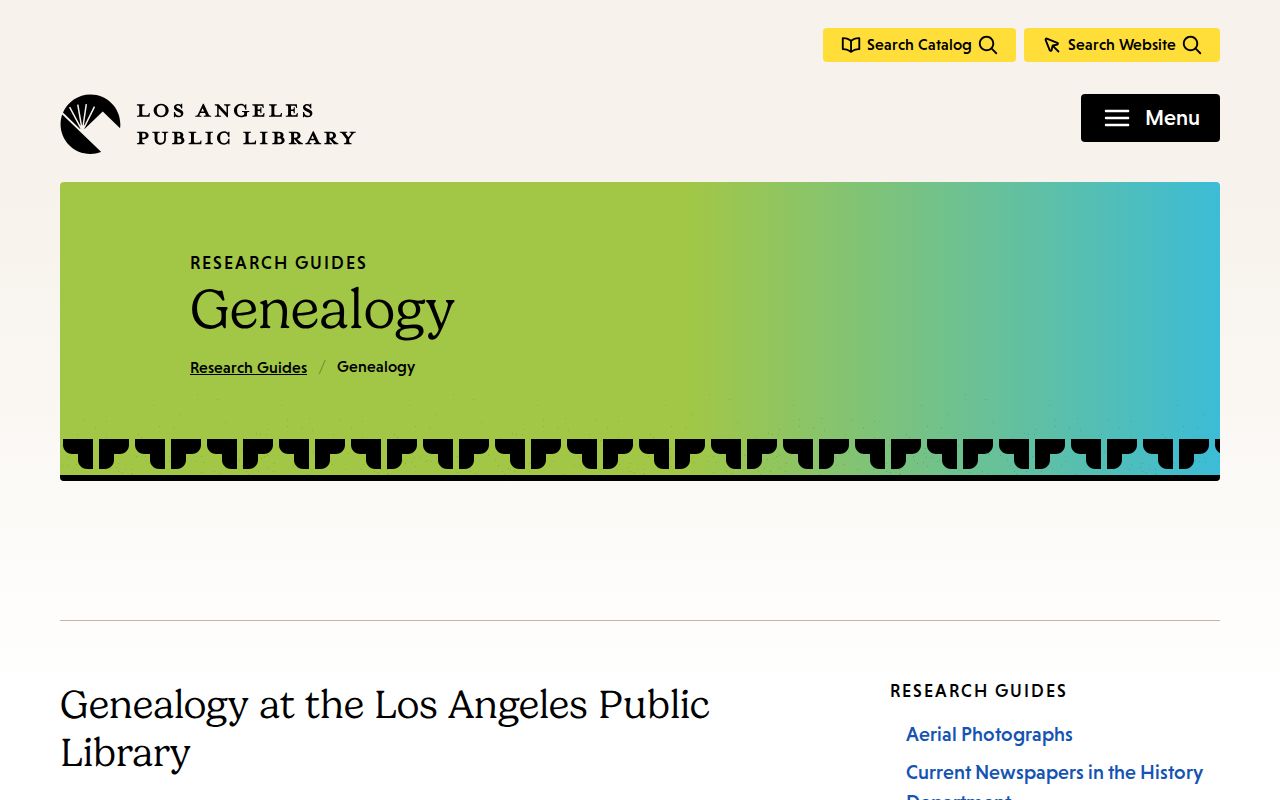
The Central Library History & Genealogy collection also holds about 52,000 genealogy titles, roughly 14,000 family histories, more than 5,000 rolls of U.S. city-directory film, telephone directories beginning in 1914, newspaper runs, and California death and marriage indexes. The full historical treatment belongs in the Los Angeles County city directory collections, where entry marks and address searching receive more space.
The library's genealogy guide is the source for the collection view below: Los Angeles Public Library History & Genealogy.
A directory can name a householder, spouse, occupation, and address for one year. It can fill the space between censuses, but a missing entry may reflect a move, death, omission, changed surname, or a change in street form.
Why 1850 Still Matters
Los Angeles County was one of California's original counties in 1850, and RR/CC states that its real-estate records reach that year. The date does not mean a complete online deed index begins in 1850. The historic holdings exist, while the public workflow remains a counter, written request, or copy route. The county's viewing guidance separates older alphabetical material from later material at Norwalk.
This is a useful Los Angeles County records story: the Assessor exposes current parcel facts, the court exposes party indexes and case summaries, LAPL exposes many digitized directories, and RR/CC keeps the deed index in a name-and-year workflow. Converting an address into an AIN and then into a party name is the key move. It prevents a false “nothing found” result from an address search the recorder never offered.
Confirming a Los Angeles County Resident
Same-name collisions are normal in a county of roughly ten million people and 88 cities. A Los Angeles County residents directory result is a lead until the comparison grid supports it. Use that grid with the full name, spelling variants, middle initial, approximate age or event date, AIN or address, related people, occupation, license, case location, and independent source. Two matching names are not two matching identities.
| Official result | Strong clue | What it cannot prove |
|---|---|---|
| Assessor parcel | Address, AIN, legal and structural facts | Every occupant at the situs |
| Recorded deed | Named parties and property transfer | That a party lived there |
| Court index | Party role, case type, date, place | Identity without matching context |
| Vital index | Event, date, county, family clue | A current address |
- Roll
- A government list or assessment record maintained for a defined purpose.
- Index
- A finding aid that points to a record; it may not include the full image.
- Parcel
- A mapped piece of land identified by an AIN and legal description.
- Criss-cross directory
- A reverse directory arranged by street and house number rather than surname.
Protected Los Angeles County Records
Some missing results are legal boundaries, not search failures. California Safe at Home gives eligible survivors and specified participants a substitute mailing address and mail forwarding. It does not erase every historic deed or database entry. Adoption files, original birth records, juvenile matters, sealed court materials, paternity records, and confidential marriages require their own statutory routes.
The public record also omits utility customers, delivery data, DMV personal information, and household relationships. A person may appear in no current directory while still having a public deed, license, court index, or old newspaper entry. Do not try to defeat a confidentiality program by joining weak clues.
Lawful use. Los Angeles County records support personal research, family history, civic understanding, and scam avoidance. Using location information to stalk, threaten, harass, impersonate, or harm another person can create criminal or civil liability.
California's Safe at Home program explains the substitute-address route and eligibility process.
Los Angeles County Public Records Requests
The California Public Records Act, Government Code sections 7920.000 and following, is the universal fallback for identifiable, nonexempt existing records held by a state or local agency. A requester does not ordinarily need a special form or statement of purpose. The agency generally determines within ten days whether the request seeks disclosable records and may issue a written fourteen-day extension for unusual circumstances. That is a determination deadline, not a promise that production will be complete by day ten.
Write a narrow request to the custodian. Name the department, record series, date range, address or subject, and preferred electronic format. Ask for existing records rather than asking the agency to create a new residents directory or answer a research question. Expect privacy, security, juvenile, medical, investigatory, personnel, attorney-client, or other exemptions to be reviewed record by record.
The governing statute is available through California Legislative Information's CPRA text. A good request leaves a clear paper trail while respecting the limits that make a Los Angeles County residents directory incomplete by design.